 MomSkoop

Relationships are supposed to bring out the best in you, not slowly chip away at who you are. Sometimes, though, the person you love can gradually change you in ways that feel uncomfortable or even harmful.
These shifts can be so subtle that you barely notice until one day you look in the mirror and barely recognize yourself. If something feels off, trust that feeling — your instincts are worth listening to.
1. You Feel More Anxious or On Edge Than Before

Feeling nervous around the person who is supposed to make you feel safe is a serious red flag.
If your stomach tightens every time you hear their ringtone or you replay every conversation wondering what you did wrong, that anxiety is telling you something important.
Healthy relationships should feel like a soft landing, not a minefield.
Constant worry about saying or doing the wrong thing wears down your mental health over time.
You deserve to feel at ease, not permanently braced for the next argument or cold shoulder.
Pay attention to how your body feels around your partner.
Persistent anxiety is not normal — it is a sign something needs to change.
2. You Do Not Recognize Yourself Anymore

There is something deeply unsettling about waking up one day and realizing the person staring back at you feels like a stranger.
Your old hobbies, your sense of humor, the values you once stood by firmly — all quietly faded into the background.
When a partner consistently dismisses who you are or rewards you only when you act a certain way, you start reshaping yourself to survive the relationship.
That slow erosion of identity is one of the most damaging things a toxic dynamic can do.
Reconnecting with your authentic self is not selfish — it is necessary.
Ask yourself honestly: when did you last feel truly like you?
3. You Have Distanced Yourself from Friends and Family

Remember when your weekends were filled with friends, family dinners, and people who genuinely knew you?
If those connections have quietly disappeared since your relationship began, that is worth examining carefully.
Isolation is one of the oldest tricks in the book for controlling someone.
It can start innocently — a partner who pouts when you make plans, or who constantly criticizes the people you love.
Before long, keeping the peace feels easier than keeping your relationships.
A shrinking support system leaves you more dependent on your partner and less able to see the situation clearly.
The people who loved you before this relationship still matter.
Do not let them slip away.
4. You Second-Guess Your Own Thoughts and Feelings

You used to trust your gut.
Now, before you even finish a thought, a voice in your head — that sounds suspiciously like your partner — steps in to tell you that you are overreacting or being too sensitive.
This pattern is called gaslighting, and it is more common than most people realize.
When someone repeatedly dismisses your feelings or rewrites events to make you question your own memory, your confidence in your own mind starts to crumble.
Trusting yourself is not arrogance — it is a basic human right.
If you constantly feel like your perceptions are wrong, consider talking to a trusted friend or counselor who can offer an outside perspective.
5. You Have Become More Negative or Reactive

Maybe you used to be the person who laughed easily and let things roll off your back.
Lately, though, small things set you off, and a short fuse has replaced your old patience.
Sound familiar?
Living in a stressful or emotionally unpredictable relationship rewires how you respond to the world.
When you are constantly bracing for conflict at home, your nervous system stays in survival mode — making you more defensive and emotionally volatile everywhere else too.
This kind of change does not happen in healthy partnerships.
If the people around you have noticed a shift in your mood or attitude, it may be time to honestly assess what — or who — is draining your emotional energy.
6. You Feel Guilty for Things That Are Not Your Fault

Somehow, no matter what goes wrong, you end up apologizing.
Their bad day becomes your fault.
Their emotional outburst becomes something you triggered.
Their disappointment is always traced back to something you did or did not do.
Being made to feel responsible for another person’s emotions and choices is emotional manipulation, plain and simple.
Over time, absorbing this blame rewires your thinking so that guilt becomes your default setting — even when you have done absolutely nothing wrong.
Healthy partners take ownership of their own feelings.
They do not use guilt as a leash.
If you are constantly apologizing just to restore peace, ask yourself whether that peace is actually worth the price you are paying.
7. You Have Lowered Your Standards and Boundaries

There was a time when certain behaviors would have been dealbreakers — full stop.
Now those same behaviors barely register because they have become so routine.
That slow drift is one of the quietest signs of a relationship pulling you in the wrong direction.
Boundaries are not walls meant to keep people out.
They are the honest expression of what you need to feel respected and safe.
When a partner pushes against them long enough, those lines start moving — and eventually, you stop drawing them at all.
Normalizing mistreatment does not make it hurt less; it just makes it harder to see.
Revisit your original values and ask yourself honestly what you have quietly accepted that you never should have.
8. You Hide Parts of Yourself to Avoid Conflict

Censoring yourself once in a while is just good social awareness.
But when you routinely swallow your opinions, pretend to like things you hate, or hide your real feelings just to avoid a blowup — that is a very different story.
Self-expression is a core human need.
When a relationship makes you feel unsafe being honest about your thoughts, interests, or emotions, you end up performing a version of yourself rather than actually living.
That performance is exhausting and deeply lonely.
You should never have to shrink yourself to fit inside a relationship.
The right partner will be curious about who you really are — not threatened or dismissive of it.
Your voice deserves to be heard.
9. Your Self-Esteem Has Taken a Hit
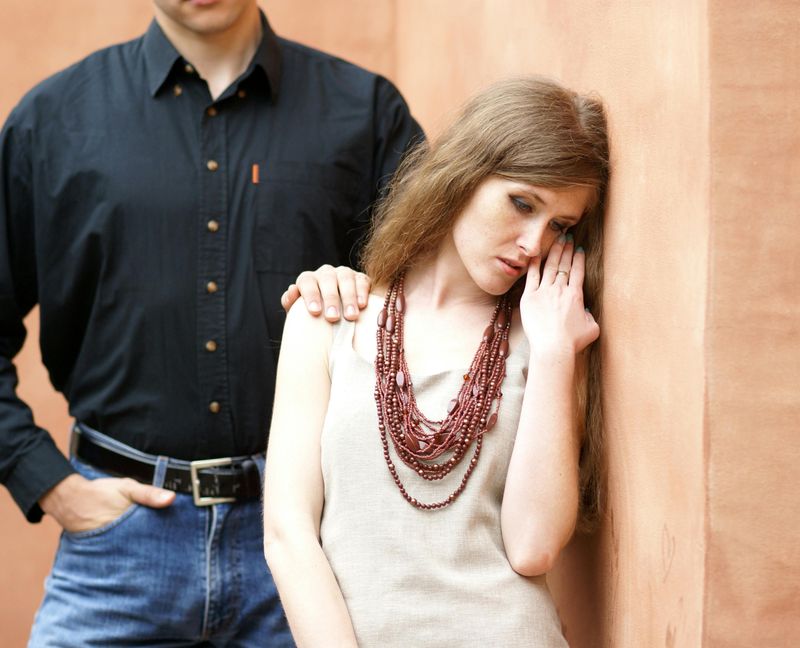
Confidence is not something you are born with in a fixed amount — it grows or shrinks depending on the environment you are in.
If yours has been quietly shrinking, the relationship around you might be the reason.
Subtle put-downs, backhanded compliments, constant criticism, or simply never being celebrated for who you are — these things add up.
Over months or years, they can leave you feeling genuinely unworthy of love, success, or even basic kindness.
Here is the truth: your worth does not depend on your partner’s opinion of you.
If being in this relationship has made you feel smaller rather than stronger, that is not love doing its job — that is damage being done.
10. You Justify Unhealthy Behavior

“They are just stressed.” “They did not mean it that way.” “Every couple goes through this.” If your inner monologue sounds like a defense attorney working overtime, that is a sign worth paying attention to.
Making excuses for a partner’s harmful behavior is one of the most common ways people stay stuck in relationships that are hurting them.
The more you rationalize, the harder it becomes to see the pattern clearly — and the further you drift from your own sense of what is acceptable.
Acknowledging a problem is not betraying the person you love.
Honesty with yourself is the first step toward either fixing what is broken or protecting yourself from further harm.
You deserve clarity, not constant spin.