 MomSkoop

Growing up without secure, consistent love can leave lasting marks on how a person connects with others. Many men carry hidden emotional wounds from childhood that quietly shape their relationships as adults.
Understanding these patterns can help you respond with more patience and compassion. Whether you recognize these signs in someone you love or in yourself, awareness is always the first step toward healing.
1. Struggles to Trust Others Fully

Trust doesn’t come easily to him.
Even when everything seems fine on the surface, there’s a quiet voice in the back of his mind waiting for something to go wrong.
He may second-guess your motives, read too much into small actions, or hold back emotionally just to protect himself.
Growing up in an unpredictable home can wire the brain to expect disappointment.
When love was inconsistent or conditional, trust starts to feel like a risk rather than a foundation.
Recognizing this pattern is not about making excuses — it’s about understanding the root so healing can actually begin.
2. Avoids Emotional Vulnerability

Opening up can feel like standing on the edge of a cliff for him.
When emotions were dismissed or punished in childhood, the brain learns that vulnerability equals danger.
So instead of sharing how he really feels, he keeps things light, changes the subject, or cracks a joke at the worst moment.
This isn’t coldness — it’s a defense mechanism that once kept him safe.
He may genuinely want deeper connection but simply not know how to get there without feeling exposed.
Patience, consistency, and a non-judgmental space can slowly help him lower those walls over time.
3. Fear of Abandonment

A slight change in your tone, a delayed text reply, or a canceled plan can send his anxiety into overdrive.
Fear of abandonment often takes root when a child’s caregivers were emotionally unavailable, unpredictable, or physically absent.
The nervous system learns to stay on high alert for signs of rejection.
What looks like clinginess or overreaction from the outside is actually a survival response running in the background.
He’s not trying to be dramatic — his body genuinely perceives small shifts as threats.
Reassurance helps, but building a track record of showing up consistently is what truly makes a difference.
4. Difficulty Regulating Emotions

One moment he seems completely shut down, and the next he’s reacting intensely to something that seems minor.
Emotional regulation is a skill that’s largely learned in childhood through safe, supportive caregiving.
When that foundation was missing, the emotional thermostat never quite gets calibrated properly.
He may feel embarrassed by his own reactions or swing between numbness and outbursts without fully understanding why.
This emotional unpredictability isn’t a character flaw — it’s a gap in early development.
Therapy, especially approaches like DBT or somatic work, can be genuinely life-changing for adults navigating this kind of internal rollercoaster.
5. Seeks Validation but Doubts It

He wants to hear that he’s doing well, that he’s loved, that he matters — but when the words actually come, something inside him struggles to believe them.
Compliments slide off like water on glass.
Affection feels nice for a moment, then gets questioned: “Do they really mean that, or are they just saying it?”
This pattern often develops when childhood praise was rare, inconsistent, or tied to performance rather than genuine care.
His self-worth got built on shaky ground.
Learning to receive love without automatically filtering it through doubt is a real and meaningful part of his healing journey.
6. Overly Independent to a Fault

Ask him for help and he’ll offer it without hesitation.
Ask him if he needs help, and you’ll almost always get a firm “I’m fine.” His independence isn’t just a personality trait — it’s armor.
When relying on caregivers led to disappointment, the safest lesson to learn was to need no one at all.
Hyper-independence can look like strength from the outside, but it quietly creates distance in relationships.
Carrying everything alone is exhausting, and it prevents genuine intimacy from forming.
Gently reminding him that needing others isn’t weakness — and consistently being reliable when he does reach out — can slowly shift this pattern.
7. Discomfort with Intimacy

Getting close to someone — really close — can trigger an almost instinctive urge to pull back.
It’s not that he doesn’t care.
Quite the opposite.
The closer things get, the more there is to lose, and that feels terrifying when love was never truly safe growing up.
He might create conflict right when things are going really well, or suddenly become distant after a deeply connected moment.
Psychologists sometimes call this “distancing behavior,” and it’s common in people with anxious or avoidant attachment styles.
Understanding this pattern — rather than taking it personally — is key to navigating it together with compassion and clear communication.
8. People-Pleasing Tendencies

Saying yes when he means no, going along with plans he dislikes, avoiding any topic that might cause friction — people-pleasing is exhausting work.
For many men who grew up in emotionally unsafe homes, keeping the peace became a survival skill.
Making others happy meant avoiding conflict, rejection, or punishment.
The tricky part is that people-pleasing often masks deep resentment over time.
He gives and gives, but never quite feels seen or appreciated.
Learning to identify his own needs — and believe they’re worth expressing — is a significant shift.
Healthy relationships require honesty, and that starts with being honest about what he actually wants.
9. Hypervigilance in Relationships
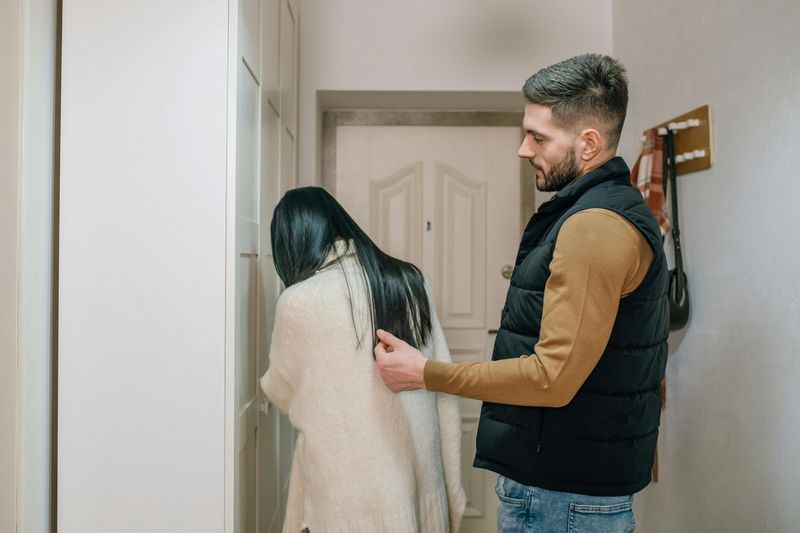
He notices everything — a slight shift in your tone, a pause before you answer, the way you looked at him during dinner.
To an outside observer, it might seem like overthinking.
But for him, scanning for danger is automatic.
His nervous system learned early on that small signals could mean big consequences.
Hypervigilance in relationships often shows up as jealousy, constant checking in, or interpreting neutral situations as threatening.
It’s mentally draining for both partners.
Helping him feel consistently safe — not by walking on eggshells, but by being clear, honest, and predictable — can gradually calm that internal alarm system over time.
10. Difficulty Expressing Needs

Some men bottle everything up until it spills over.
Others drop vague hints and then feel hurt when no one picks up on them.
Either way, the root is the same: expressing a need once felt pointless or even dangerous.
Maybe needs were ignored, mocked, or used against him as a child.
So now, he either suppresses what he wants entirely or expects the people who love him to “just know” without being told.
Both patterns lead to frustration and disconnection.
Learning to say “I need this from you” — clearly and without shame — is one of the most powerful relationship skills he can build.
11. Attracted to Unstable Relationships

Chaos, unpredictability, hot-and-cold dynamics — none of these are fun, but they can feel strangely familiar.
When a child grows up in a home where love was inconsistent, the nervous system actually calibrates to that level of stimulation.
Calm, stable love can feel boring or even suspicious by comparison.
He might find himself repeatedly drawn to relationships that mirror early dysfunction — not because he enjoys pain, but because it feels like home on a neurological level.
Recognizing this pull is genuinely uncomfortable work.
But it’s also one of the most important realizations on the path to choosing — and truly valuing — a relationship that is actually healthy.
12. Deep Sense of Not Being Enough

Underneath many of the other signs on this list lives a single, painful core belief: that he is not enough.
Not smart enough, not lovable enough, not worthy of being chosen and kept.
When children don’t receive unconditional love, they often conclude that the problem is them — not the adults who failed them.
He may work overtime to earn affection, over-apologize, or downplay his own value in relationships.
Healing this wound isn’t quick, and it usually benefits greatly from professional support.
But every moment he is loved consistently and without conditions chips away at that old belief, replacing it with something far more truthful.