 MomSkoop

Catching a lie sounds like something only detectives or mind readers can do, but the truth is, our bodies often give us away without us even realizing it.
Whether it’s a nervous gesture or a split-second pause, these small signals can reveal a lot about what’s really going on inside someone’s head.
Scientists who study human behavior have identified patterns that show up when people aren’t being fully honest.
Knowing what to look for could help you become a sharper, more aware reader of the people around you.
1. Sudden Stillness or Freezing
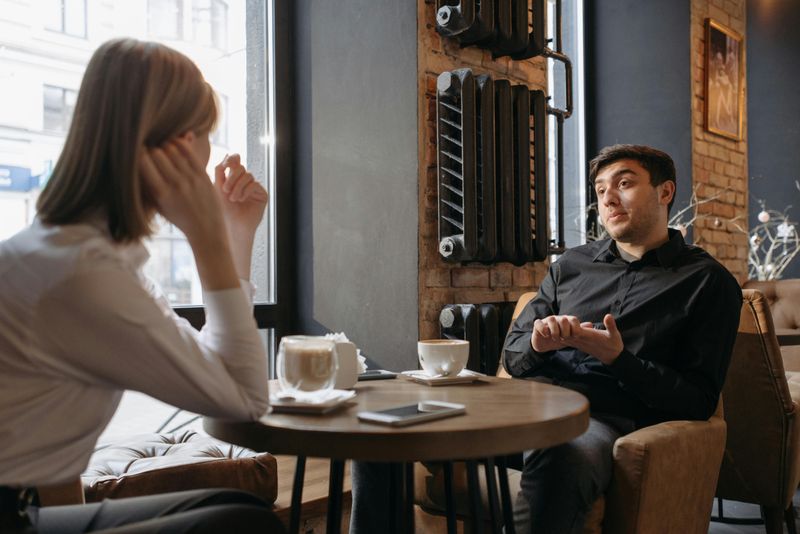
Most people assume liars fidget nervously, but here’s the twist — sometimes the opposite happens.
When someone is trying hard to control their story, their whole body can go strangely still, almost like they’ve hit a pause button.
This sudden “freeze” is the brain’s way of conserving mental energy.
Crafting a believable lie takes a lot of focus, and the body quiets down to help the mind concentrate.
It’s an instinct, not a choice.
Watch for someone who was relaxed and moving naturally, then suddenly becomes motionless mid-conversation.
That shift in stillness can be more telling than any nervous twitch.
2. Inconsistent Eye Behavior

Forget the old rule that liars always look away.
Eye behavior during deception is actually much more complicated than that.
Some people avoid your gaze entirely, while others overdo it with a stare that feels a little too locked-in and deliberate.
Both extremes can be red flags.
Avoiding eye contact might signal discomfort, but maintaining unnaturally intense eye contact can mean someone is consciously trying to appear confident and honest.
The real clue is inconsistency — a shift from their normal eye behavior.
If someone’s gaze pattern suddenly changes during a specific topic, that change itself is worth noticing.
3. Delayed Reactions or Micro-Delays

When someone asks you what you had for breakfast, you answer almost instantly.
But ask a liar a simple question, and you might notice a tiny, telling pause before they respond.
That micro-delay is the brain buying itself time to build a believable answer.
It’s like watching someone mentally edit their words before they speak.
Even a half-second hesitation on a question that should be easy can be a quiet alarm bell.
Pay attention to how quickly someone responds to straightforward questions.
A lag that doesn’t match the difficulty of what was asked often signals that something is being carefully constructed behind the scenes.
4. Touching or Covering Vulnerable Areas

There’s something almost instinctive about the way our hands move toward our face or neck when we feel exposed or threatened.
Researchers call these “self-soothing” gestures, and they tend to spike when someone is being dishonest.
Touching the mouth, covering the throat, or rubbing the back of the neck are all subtle signals that the body is under stress.
It’s as if the hand is trying to physically block the words coming out.
These gestures won’t tell you everything on their own, but when they appear right after a specific statement, they’re worth paying attention to as part of a larger pattern.
5. Mismatch Between Words and Body Language

Words and body language are supposed to work as a team.
When they don’t, something interesting is happening.
A classic example is someone saying “yes” while their head gives a subtle shake of “no” — the body and the mouth are telling different stories.
This kind of mismatch is called a “leakage” cue, where the body accidentally reveals what the words are trying to hide.
It happens because conscious thought controls speech, but body movements are much harder to fake consistently.
Spotting these contradictions takes practice, but once you start looking for them, they become surprisingly easy to notice in everyday conversations.
6. Changes in Breathing or Swallowing

Stress does a number on the body, and lying — even small lies — triggers a stress response.
One of the most visible side effects is a change in breathing.
You might notice someone’s chest rising faster or their breaths becoming shorter and shallower.
Frequent swallowing is another giveaway.
When anxiety kicks in, the mouth produces less saliva, making swallowing more noticeable and deliberate.
It’s an automatic physical reaction that’s hard to fake or suppress on demand.
These signs are most useful when you notice a shift from someone’s normal baseline.
A sudden change in their breathing rhythm during a specific moment in a conversation can speak volumes.
7. Unnatural Hand or Arm Behavior

Hands are some of the most expressive parts of the human body.
Watch someone tell an exciting story — their hands move, gesture, and almost dance along with their words.
So when those hands suddenly go quiet or disappear, that’s a notable shift.
Liars often unconsciously pull their hands back, sit on them, or press them flat against their legs.
It’s a way of trying to control potential “leaks” in body language, but the very act of controlling them stands out.
Overly stiff arms or hands that hover awkwardly without natural movement can signal that someone is working overtime to manage how they appear during a conversation.
8. Overly Controlled or Rehearsed Movements

Genuine emotion tends to look a little messy and spontaneous.
So when someone’s movements seem almost too polished — like they’ve practiced the whole conversation in front of a mirror — that smoothness can feel off.
Rehearsed body language often lacks the small, natural imperfections that come with authentic expression.
Gestures arrive a beat too late, smiles don’t quite reach the eyes, and posture stays weirdly perfect throughout the interaction.
Think of it like watching an actor who’s slightly overdoing it.
The performance is technically correct, but something feels hollow.
That gut feeling you get?
It’s often picking up on exactly this kind of overly managed, unnatural presentation.