 MomSkoop

Words reveal a lot about how someone truly feels about the people around them.
When a man consistently uses certain phrases, it can be a clear sign that he doesn’t fully respect women.
Recognizing these patterns early can protect your confidence and help you set healthy boundaries.
Pay close attention to the language people use, because actions and words together tell the full story.
1. “Calm Down”
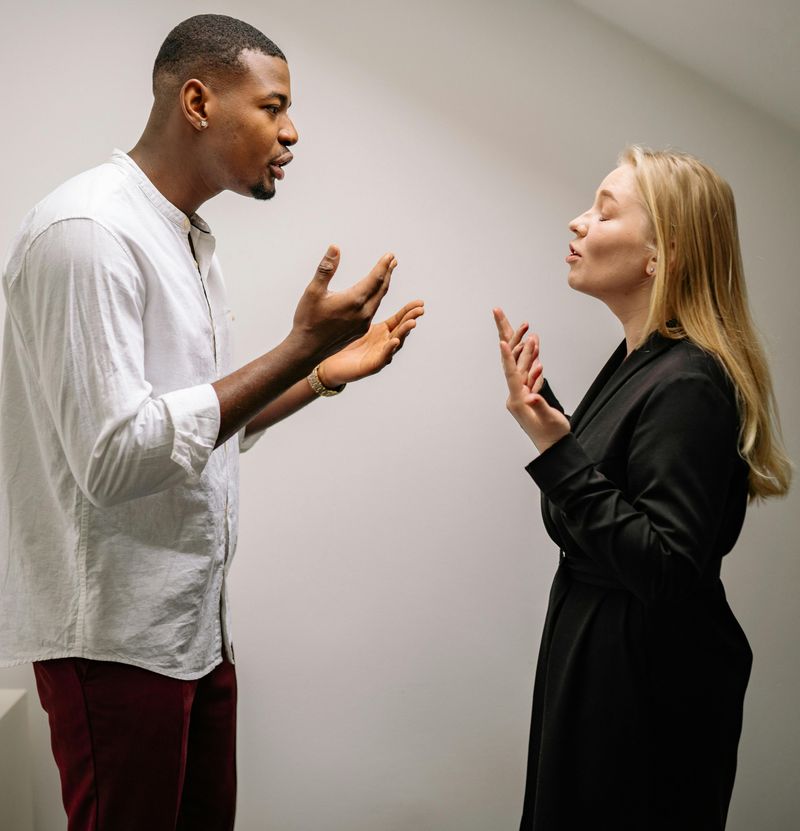
Nobody likes being told to “calm down” when they’re expressing something that genuinely matters to them.
Instead of listening, this phrase shuts the conversation down before it even gets started.
It sends a message that her emotions are the problem, not the situation causing them.
Healthy communication means actually hearing someone out, not silencing them.
When a man uses this phrase regularly, he’s choosing control over connection.
Real respect looks like saying, “I hear you,” not “stop feeling what you’re feeling.” Emotions aren’t a malfunction.
They’re valid signals that deserve acknowledgment, not a quick dismissal.
2. “You’re Overreacting”

Telling someone they’re overreacting is a sneaky way of avoiding responsibility.
Rather than looking at what caused the reaction, the focus shifts entirely to how she’s responding.
That’s not fair, and it’s not honest either.
Everyone’s feelings come from somewhere real.
When a man uses this phrase to dodge difficult conversations, he’s essentially saying his comfort matters more than her truth.
Over time, hearing this repeatedly can make a woman question her own judgment.
That kind of self-doubt is damaging.
Healthy relationships require both people to take each other’s reactions seriously, even when it feels uncomfortable to do so.
3. “You’re Too Sensitive”

Sensitivity is not a flaw.
Yet this phrase turns it into one, placing all the blame on her emotional response rather than examining what triggered it.
It’s a classic deflection move.
When someone is hurt by a comment or action, the respectful response is curiosity, not criticism.
Saying “you’re too sensitive” shuts that door completely.
It teaches her to suppress her feelings to avoid conflict, which is an unhealthy dynamic.
Over time, this pattern erodes self-trust and creates emotional distance.
A man who respects women takes ownership of his words and asks, “Did I say something hurtful?” instead of pointing the finger back.
4. “Let Me Explain This in a Simpler Way”

There’s a version of “helping” that doesn’t feel helpful at all.
Offering to simplify something she didn’t ask to have simplified is a subtle way of suggesting she’s not smart enough to keep up.
It’s patronizing, plain and simple.
This phrase often shows up in professional settings or during debates, and it stings because it’s disguised as kindness.
But the underlying message is clear: he thinks he’s smarter.
Respecting someone means trusting that they can follow along without being talked down to.
If she asks for clarification, that’s one thing.
Assuming she needs it?
That’s condescension wearing a helpful mask.
5. “Actually…”

One word.
Five letters.
And somehow it manages to carry a mountain of arrogance. “Actually” used as a constant interruption is less about sharing information and more about establishing dominance in the conversation.
Men who habitually use this word to cut women off position themselves as the final authority on everything.
It’s not about being correct.
It’s about making sure she knows he thinks she isn’t.
This behavior is especially common in group settings where it can undermine her credibility in front of others.
True confidence doesn’t need to correct people mid-sentence.
It listens first, then contributes thoughtfully to the conversation.
6. “That’s Cute”

Calling a woman’s idea or ambition “cute” is one of the quietest forms of disrespect.
It sounds almost like a compliment, but the tone behind it speaks volumes.
It reduces serious goals to something small and adorable, not worthy of real consideration.
Ambition deserves to be met with curiosity and encouragement, not a patronizing smile.
When a man responds this way, he’s signaling that he doesn’t take her seriously as an equal.
Over time, this can chip away at her confidence and make her less likely to share her ideas at all.
That’s a real loss, for everyone involved.
7. “You Wouldn’t Get It”

Few phrases are as quietly insulting as this one.
Assuming she won’t understand something before she’s even had the chance to engage is a direct attack on her intelligence.
It shuts her out before the conversation begins.
This phrase often shows up around topics like sports, finance, or technology, areas where women are sometimes stereotyped as less knowledgeable.
But stereotypes aren’t facts, and assuming incompetence is never respectful.
A man who truly values the women in his life invites them into conversations rather than locking the door.
Curiosity is a two-way street, and everyone deserves the chance to engage and learn.
8. “You Should Smile More”

Nobody is obligated to perform happiness on demand.
Yet this phrase treats a woman’s face like a public display that should always look pleasant and agreeable.
It’s controlling, even if it sounds casual.
Comments about how a woman should look or present herself send a clear message: her job is to appear pleasing, not to simply exist as she is.
It also completely ignores whatever she might be thinking or feeling in that moment.
Policing someone’s expression is a form of control, not care.
Respect means letting people show up authentically, whether that means smiling, thinking, concentrating, or just being quiet.
9. “Relax, It Was Just a Joke”

Hiding behind humor is one of the oldest tricks in the book.
When a comment lands badly and the response is “relax, it was just a joke,” the real message is: your feelings don’t matter as much as my entertainment.
Jokes that target someone’s gender, appearance, or intelligence aren’t harmless.
And when the punchline is always at her expense, that pattern says something important about how he views her.
Accountability doesn’t disappear just because something was delivered with a laugh.
A person who respects women can hear that a comment was hurtful, own it genuinely, and choose better next time without making her feel dramatic for speaking up.
10. “You’re Being Dramatic”

Labeling a reaction as “dramatic” is another way of saying, “I don’t want to deal with this.” It reframes a valid emotional response as irrational exaggeration, putting her on the defensive instead of keeping the focus on the real issue.
This phrase is particularly harmful because it can make women second-guess themselves constantly.
Was I too much?
Did I blow it out of proportion?
That internal spiral is exhausting and unfair.
Strong relationships are built on the ability to handle hard emotions together, not dismiss them.
When someone consistently uses this phrase, they’re prioritizing their own comfort over her right to feel and be heard without judgment.
11. “I Was Just Trying to Help”

Unsolicited advice wrapped in good intentions is still unsolicited.
When help wasn’t asked for and she points that out, deflecting with “I was just trying to help” shifts the blame entirely onto her reaction.
This phrase makes it hard to have an honest conversation because suddenly she’s the one who seems ungrateful or unreasonable.
But offering help someone didn’t request can feel patronizing, especially when it happens repeatedly.
It implies she can’t handle things on her own.
Real support means asking, “Would you like my input?” before jumping in.
Respecting someone’s autonomy means trusting them to ask for help when they actually need it.
12. “Don’t Worry Your Pretty Little Head About It”

This phrase is so outdated it almost sounds like a parody, but it still gets used.
And every time it does, it carries the same message it always has: your looks are your value, and your thoughts are not welcome here.
Rooted in old-fashioned gender roles, this saying implies that women are decorative and men are the decision-makers.
Even said with a smile, it’s belittling.
It dismisses her intelligence and curiosity in one breath.
No topic is off-limits for women, whether it’s money, politics, business, or anything else.
Respect means treating her as a full person, not a pretty distraction to be kept comfortable and uninformed.