 MomSkoop

Marriage can be one of the most rewarding relationships in life, but it can also become confusing and painful when one partner shows narcissistic traits. Many people don’t realize they’re dealing with these patterns because the behaviors can be subtle, gradual, and easy to excuse.
Recognizing these signs is the first step toward protecting your emotional health and making informed decisions about your relationship.
1. Chronic Victimhood and Guilt-Tripping

Somehow, every disagreement ends with you apologizing, even when you started the conversation with a legitimate concern.
A partner with narcissistic traits is skilled at flipping the script, turning your valid complaint into proof of how much you have hurt her.
She becomes the wounded party almost instantly.
This pattern is called chronic victimhood, and it works as a powerful control tool.
By always positioning herself as the one who suffers, she avoids accountability while keeping you emotionally off-balance.
You end up walking on eggshells just to avoid triggering another guilt spiral.
Over time, recognizing this cycle is key.
Your feelings and concerns are valid, and a healthy relationship never requires one person to constantly apologize for bringing them up.
2. Obsession with Public Image vs. Private Coldness

To the outside world, she appears to be the perfect wife, devoted mother, and gracious neighbor.
Social media feeds are carefully curated, public outings are picture-perfect, and compliments from strangers come easily.
She works hard to maintain that flawless reputation.
Behind closed doors, though, the warmth disappears.
Criticism replaces kindness, and emotional distance becomes the norm.
The version of her that friends and family admire rarely shows up at home, leaving her spouse confused and emotionally starved.
This gap between public persona and private behavior is a significant red flag.
When the performance matters more than the actual relationship, the marriage becomes a stage rather than a safe place for genuine connection.
3. Weaponized Emotion and Tearful Deflection

Picture this: you finally gather the courage to bring up something that has been bothering you for weeks.
Before you finish your second sentence, the tears start flowing, and suddenly you are comforting her instead of being heard.
That shift is not an accident.
Weaponized emotion is a deflection strategy.
Dramatic crying, emotional outbursts, or sudden distress during confrontations are used to derail honest conversations and force the other person into a caretaker role.
The original issue gets buried under layers of emotional chaos.
Genuine emotional responses are healthy and normal, but there is a difference between authentic vulnerability and calculated displays.
If her emotions consistently appear only when accountability is on the table, that pattern deserves serious attention.
4. Subtle Isolation and Triangulation

Friendships start to feel strained.
Family dinners become awkward.
Somehow, the people who were once your closest supporters seem to pull away, and you are not quite sure why.
Chances are, it did not happen by accident.
Triangulation involves using third parties, whether friends, family members, or colleagues, to create conflict, spread half-truths, or manufacture drama.
A partner with narcissistic traits may subtly poison your relationships to ensure that you have fewer people to turn to for support or perspective.
Isolation keeps a partner dependent and easier to control.
If you notice your social world shrinking while hers seems to grow, pay attention to who is steering those changes and why your connections keep mysteriously falling apart.
5. Competitiveness and Envy Within the Marriage

Getting a promotion, finishing a personal project, or simply receiving a compliment from someone else should be cause for celebration.
But in a marriage shaped by narcissistic dynamics, your wins can feel like threats rather than shared victories.
Rather than cheering you on, she may downplay your achievements, quickly redirect the conversation to her own accomplishments, or subtly imply that your success was luck rather than effort.
Envy dressed up as indifference can be hard to spot at first.
A healthy partnership thrives on mutual encouragement.
When one person consistently struggles to celebrate the other without making it about themselves, the relationship loses the teamwork and genuine support that strong marriages are built on.
6. Relentless Passive-Aggressive Control

Control does not always look like shouting or issuing demands.
Sometimes it looks like a long, loaded silence after you made a decision she disagreed with.
Or a backhanded compliment that leaves you strangely deflated.
Or affection that disappears the moment you do not comply.
Passive-aggressive control is quieter than open conflict, which makes it harder to call out.
Sulking, withholding warmth, or delivering subtle digs wrapped in a smile are all tools used to steer household dynamics without ever having to own the manipulation openly.
When you find yourself constantly adjusting your behavior just to avoid the cold shoulder or a loaded sigh, that is a sign that control is operating beneath the surface of your everyday interactions.
7. Gaslighting and Rewriting History

You remember the conversation clearly.
You remember exactly what was said, where you were standing, and how it made you feel.
Then she tells you it never happened, or that you completely misunderstood, or that you are being dramatic.
And somehow, you start to wonder if she is right.
Gaslighting is one of the most disorienting experiences in any relationship.
Over time, consistent denial of past events or distortion of shared memories can erode your trust in your own perception.
That self-doubt is not a coincidence; it is the intended outcome.
Keeping a private journal of significant conversations and events can help you stay grounded in your own reality when someone else is actively working to rewrite it.
8. Hyper-Sensitivity to Criticism

You chose your words carefully.
You kept your tone soft, your timing considerate, and your feedback gentle.
Still, the reaction you received was explosive, resentful, or deeply wounded, as if you had launched a personal attack rather than shared a small concern.
People with high narcissistic traits often carry a fragile self-image beneath a confident exterior.
Any feedback, no matter how minor, can feel like a fundamental threat to their sense of self.
The resulting reaction is frequently far bigger than the situation warrants.
Walking on eggshells to avoid triggering an outsized reaction is exhausting and unsustainable.
Healthy relationships require the ability to give and receive honest feedback without one partner fearing a meltdown every time a concern is raised.
9. Conditional Affection

Love should not feel like a reward system, but in some marriages, that is exactly what it becomes.
Warmth flows freely when you agree, comply, or perform in ways that meet her expectations.
The moment you push back or fall short, the affection shuts off like a faucet.
Using intimacy, kindness, and emotional warmth as currency is a form of manipulation.
It trains a partner to associate their own comfort and love with obedience, creating a dynamic that feels more transactional than genuine.
Real love does not disappear the moment you disagree.
If you notice that affection in your marriage is tied directly to compliance rather than genuine connection, that pattern is worth examining honestly and carefully.
10. Lack of Genuine Empathy

After a rough day, a painful loss, or a health scare, most people hope their partner will show up for them.
Empathy, even in its simplest form, a hand on the shoulder or a listening ear, can make a hard moment bearable.
When that comfort is absent, it leaves a mark.
A partner with narcissistic traits may struggle to offer genuine emotional support.
Your grief or pain may be minimized, dismissed as overreacting, or quickly redirected to how your situation inconveniences her.
The focus rarely stays on you for long.
Feeling consistently invisible during your hardest moments is a serious issue.
Emotional support is a basic pillar of marriage, and its absence should never be normalized or explained away as personality quirks.
11. Boundary Disregard Under the Guise of Help

She checks your messages because she worries about you.
She makes decisions on your behalf because she knows best.
She reorganizes your personal space because she thought it would help.
Each violation is wrapped in the language of care, making it difficult to object without seeming ungrateful.
Framing boundary violations as devotion is a clever way to avoid accountability.
Over time, your personal space, privacy, and autonomy shrink, while her justification remains the same: she was only trying to help.
The intent sounds kind, but the impact is controlling.
Every person in a marriage deserves boundaries that are respected, not negotiated away under the cover of good intentions.
Love that requires you to surrender your privacy is not as caring as it claims to be.
12. Parent-Child Dynamics and Exploitation

Children in a home with a narcissistic parent often end up carrying emotional weight that does not belong to them.
They may be used as messengers during conflicts, praised excessively as status symbols, or subtly encouraged to take sides in parental disagreements.
At the same time, your parenting efforts may be constantly criticized or undermined.
The goal is not better parenting; it is maintaining dominance.
By positioning herself as the superior parent, she keeps you feeling inadequate and easier to control within the family structure.
Children thrive when both parents work together as a team.
When one partner consistently uses kids as emotional tools or weapons, the damage extends well beyond the marriage and into the lives of the children themselves.
13. Zero Genuine Accountability
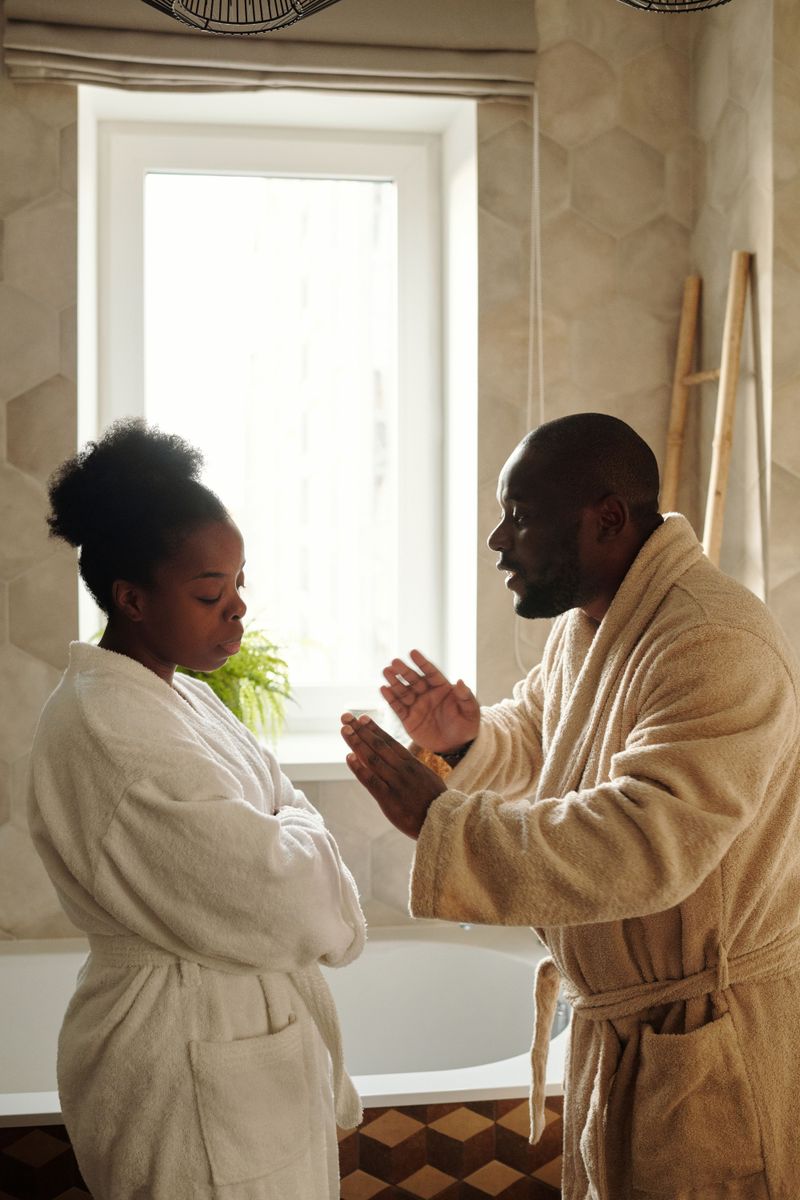
A sincere apology has a very specific feel to it.
It acknowledges the harm caused, takes ownership without conditions, and does not circle back to what you did wrong.
That kind of apology is rare, or completely absent, when narcissistic traits are running the show.
Instead, accountability gets replaced by deflection.
Phrases like “I only did that because you…” or “You always make me feel like I have to…” shift the blame before any real ownership can take root.
Denial and reframing become the default responses to any confrontation.
Without accountability, real repair cannot happen.
Healthy relationships require both people to own their mistakes honestly.
If apologies in your marriage always come with a “but,” that single word is doing a lot of damage.